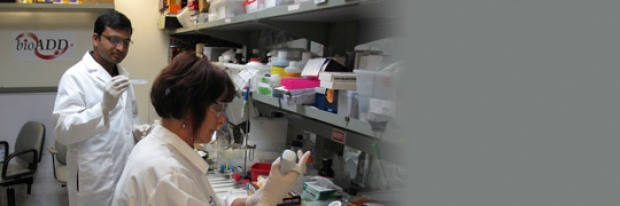
Past members of BioADD Research Team |
|
| Si Wan Kim, PhD |
 |
Dr. Si Wan Kim received his Ph.D. in the program of Genes and Development from University of Texas MD Anderson Cancer Center. He completed his postdoctoral training in Stem Cell Genomics from Stanford University. He has wide experiences in the analysis of
genomic and molecular basis for cell fate determination in embryonic
and induced pluripotent stem cells, and comparison of in vitro derived
tissues with in vivo counterparts. He also has strong experiences in identification of cell specification signaling target and biomarker
candidates using mouse as a preclinical animal model. His research
interests include stem cell survival and regenerative approaches in
neuronal disorders.
|
|
| |
 |
Eliza Anna Ruben, PhD
Research Scientist
|
|
| Hai Li |
 |
Hai Li received his Ph.D. from the University Claude Bernard Lyon 1/International Agency for Research on Cancer (WHO) in cellular biology. His research interests lie in the use of conventional and conditional knockout cells and mouse models to gain understanding of epigenetics, chromatin remodeling, cell cycle, and gene regulation. |
Recently, he has studied the underlying mechanisms of a potent natural hypolipidemic small molecule, namely berberine. His current research focuses on gaining a deeper understanding of a role for inflammation in the pathogenesis of pulmonary arterial hypertension and developing therapeutic approaches to the disease. |
|
| Yan Song |
 |
Yan Song received her Ph.D. in Molecular Genetics from Duke University. She pursued her postdoctoral research in stem cell biology at Stanford University. She is an expert in Drosophila molecular genetics, biochemistry and imaging. At BioADD, her current research interests focus on drug discovery for neurodegenerative diseases. |
|
| Zeynep Araci |

|
Zeynep Araci has completed her PhD at the Chemistry and Biochemistry Department at the University of Arizona. She has extensive experience and knowledge in the fields of electrochemistry, spectroscopy and surface sensitive techniques. She is also skillful in PDMS mold and chip making, soft lithography methods for microfluidic devices and testing of these devices. She has joined the BioADD research team on September 2011.
|
|
| Matthew Lippi |
 |
Matt studied Biology as an undergraduate at University of California, Irvine and in addition to acting as lab manager he assists in development and fabrication of microneedles, breathable particles and other drug delivery systems.
|
|
| Dean Nehama |

|
Dean joined the BioADD Center even before it was called the BioADD Center. He worked on four main projects throughout his term: (1) Binding affinity characterization of small molecules drugs for nerve regeneration (with the Longo lab); (2) fabrication of fetal skill mimetic biomaterial and thermoresponsive hydrogel for ex vivo organogenesis (with the Gurtner lab); (3) management of the MALDI-TOF facility, and (4) lab management. |
In June 2012, Dean joined the MD-PhD program at the University of North Carolina – Chapel Hill (UNC). He is currently on track in subspecializing in geriatrics and doing research in age-related diseases such as cancer and Alzheimer’s disease. He is also interested in being an educator, both in the educational institution at which he would eventually work and in the greater community. We wish him all the luck in his endeavors! |
|
| Aaron Tan |
Visiting Scholar |
 |
Aaron’s research interest primarily revolves around nanotechnology and regenerative medicine, with a particular focus on novel nanoscale drug delivery systems. Apart from being a good team player in the lab, he also displays initiative by spearheading a few research projects, for example, the application of exosomes as a nanoscale cancer vaccine, as well as the bioconjugation of quantum dots to carbon nanotubes in cancer theranostics.
|
|
| Ben Reinhardt |
 |
Ben began working as a Stanford undergraduate researcher at the BioADD center in January of 2010. His first project involved developing a biocompatible thermogel for use in potential stem cell therapies. In the summer of 2010, he was supported by a chemical engineering departmental grant to study the use of nanocapsules in drug-delivery applications. He will attend the Baylor College of Medicine in Houston, TX starting in the summer of 2012.
|
|
| Jesse Ikeme |
 |
Undergraduate Assistant
Jesse Ikeme worked in the BioADD lab from March to September 2010. As an undergraduate assistant, Jesse helped characterize drug delivery solutions created in the lab. Currently, he is studying the role of melanopsin in the circadian system with Craig Heller in the Stanford Biology department and applying to medical school.
|
|
| Jessica Trang |
|

|
Developed a drug delivery system to test its wound healing capabilities on a diabetic mice model. Characterized the drug delivery system with liquid chromatography-mass spectrometry and Western blot. Assisted colleagues in characterizing other drug delivery systems with binding assays, mass spectrometry, and 3D confocal imaging
|
|
| Priyanka Naik, BS |
|
Predoctoral Scientist
|
|
| Marcos G Hung |
 |
Predoctoral Scientist |
|
| John P. Chiang |
|
 |
Research Scientist |
| |
|
| Christopher Peeters |
 |
Research Scientist
|
|
| |
|